Laravel web application example
Web hosting company cuts support tickets by 40%
We replaced an outdated WHMCS system with an intuitive Laravel application that automated domain management, enhanced user experience, and drove a 25% increase in customer satisfaction.
Background
Chillidog Hosting provides easy-to-manage hosting services built to scale with growing businesses. Supporting RapidWeaver, WordPress, and Weebly, it serves thousands of customers worldwide with hosting, domain management, and email services. As the customer base expanded, the operational cracks in their legacy WHMCS-based platform became impossible to ignore. What had once been functional was now actively costing them customers, developer hours, and competitive ground.

Challenge
Legacy WHMCS interface frustrating customers and driving up support volume
Outdated PHP codebase consuming developer capacity on maintenance instead of growth
Rigid platform architecture blocking new service offerings and revenue expansion
Poor API documentation creating integration bottlenecks and slowing every update

Solution
Rather than a costly rip-and-replace, we built a modern Laravel application as a clean frontend layer over the existing WHMCS backend. This preserved proven billing and provisioning logic while completely eliminating the UX and performance liabilities. One unified platform for domains, hosting, and payments.

Results
40% reduction in support tickets through self-service workflows and an interface that doesn't require a support call to navigate
70% faster platform performance on the same infrastructure
25% measurable improvement in customer satisfaction scores
Full operational scalability - new services and features ship without architectural constraints

Lucky Media is an outstanding group to collaborate with. They’re trustworthy, reliable, and passionate about their work. I’d highly recommend them for any organization seeking value and, most importantly, results.

Gregory Barchard
Owner @ Chillidog SoftwareLet’s chat
Talk to our founders. Let's figure out what's actually slowing you down.
Challenges
The legacy platform wasn't just a UX problem, it was creating compounding business costs across every layer of the operation:
Customer experience breakdown: The WHMCS interface was designed for administrators, not end users. Customers trying to manage domains, update hosting packages, or pay invoices hit dead ends that converted directly into support tickets. Every frustrated user who couldn't self-serve became a cost center. The brand perception damage was harder to quantify but equally real.
Operational cost inflation: The underlying PHP codebase required constant developer attention just to stay functional. Routine maintenance was consuming engineering capacity that should have been funding new features and product growth. The team was running to stand still.
Growth limitations: The rigid system architecture made it an engineering project in itself to add new service offerings, email security, regional server options, and backup products. Every potential revenue expansion required a bespoke workaround. The platform had become a ceiling, not a foundation.
Development bottlenecks: Sparse API documentation across the WHMCS, Enom, and payment integrations meant that every update carried discovery risk. Developers couldn't move with confidence, and that uncertainty translated directly into slow release cycles and delayed responses to market opportunities.
Our solution
We delivered a platform that runs the business, not the other way around.
The core architectural decision was not to replace WHMCS. Every other proposal Chillidog received quoted a full migration. We audited the system and reached a different conclusion: the billing logic, provisioning workflows, and customer data inside WHMCS were solid assets. The frontend was the liability.
Building a Laravel/Inertia layer that synced with WHMCS rather than replacing it cut scope in half, eliminated billing migration risk, and let us focus engineering effort entirely on the problems that were actually costing customers and money.

Enhanced user experience
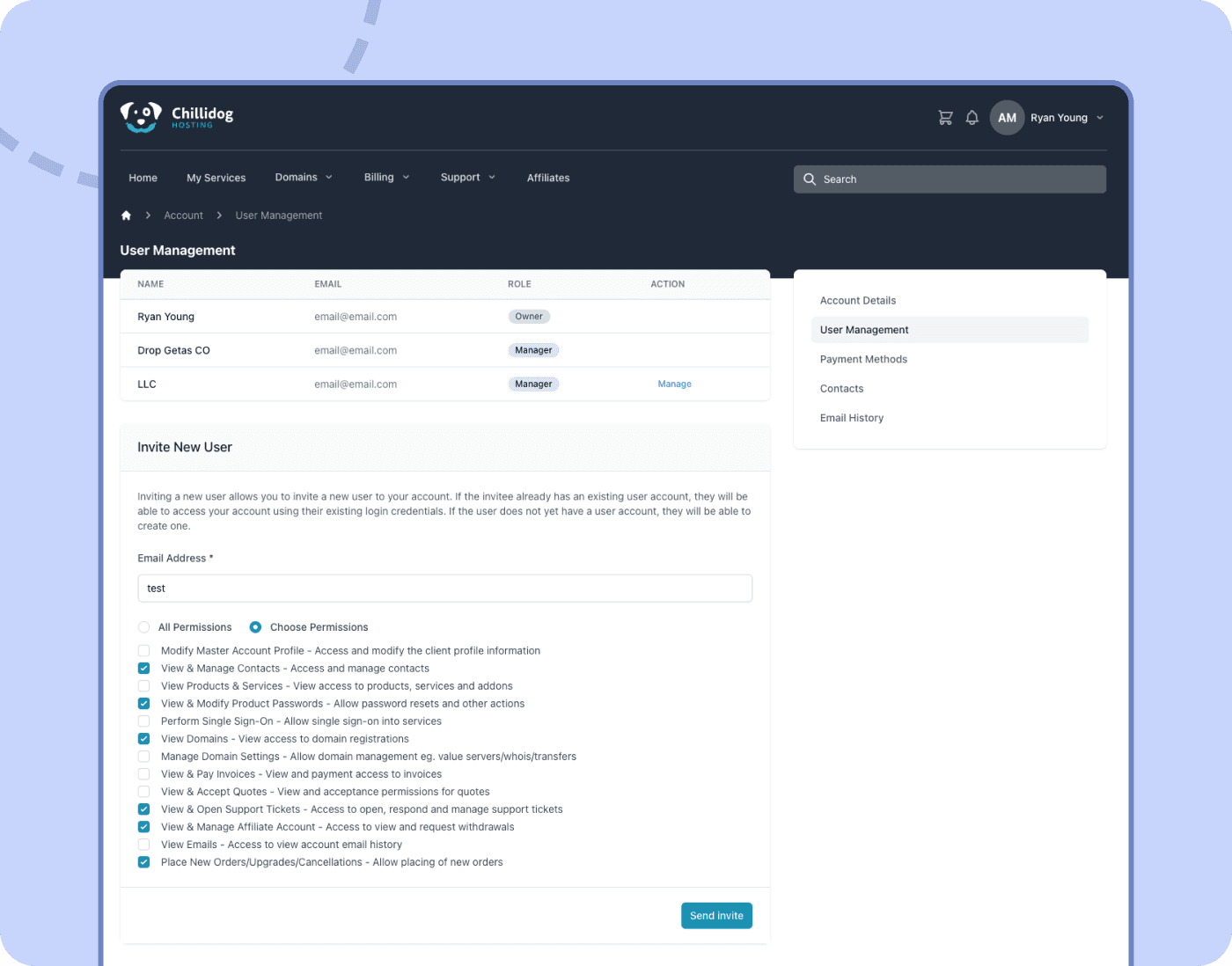
We rebuilt the customer-facing interface from scratch, clean, responsive, and designed around how hosting customers actually think about their services, not how WHMCS organizes its database.
Why this matters: Every UX friction point that disappears is a support ticket that never gets filed. At Chillidog's customer volume, that compounds fast. A 40% reduction in support tickets is not a design win, it's an operational cost reduction that shows up on the P&L.
Technical deep dive: We used Laravel, Inertia, and React to build a dynamic, real-time application that syncs state with WHMCS seamlessly. Inertia eliminated the need for a separate API layer while giving us the full reactivity of a modern SPA, faster to build, faster to run, and significantly easier to maintain than a decoupled architecture would have been at this scope.
Streamlined domain management
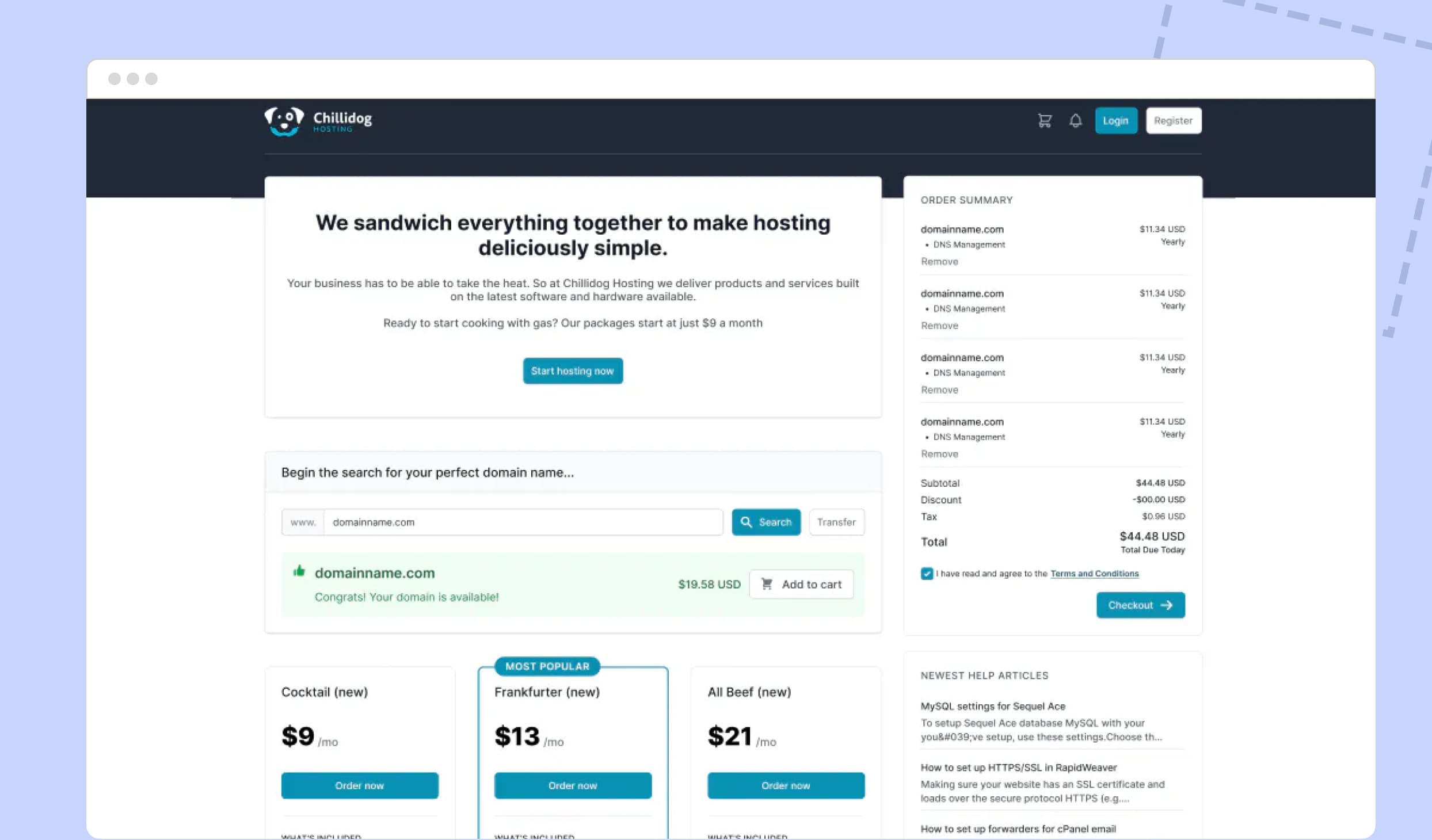
We redesigned the entire domain workflow (search, availability check, purchase, and ongoing management) into a linear, low-friction sequence that a customer can complete without documentation or support.
Why this matters: Domain management is the highest-friction touchpoint in hosting. It's also the one most likely to generate a support ticket when it goes wrong. Simplifying this workflow was the single highest-leverage UX change in the project, and it directly contributed to the support ticket reduction.
Technical deep dive: The platform integrates directly with the Enom API for all domain operations, giving us access to reliable, real-time availability data and a robust backend for registration, transfers, and renewals. We mapped the full Enom API surface during discovery and built only what customers actually needed, keeping the integration tight and the maintenance surface small.
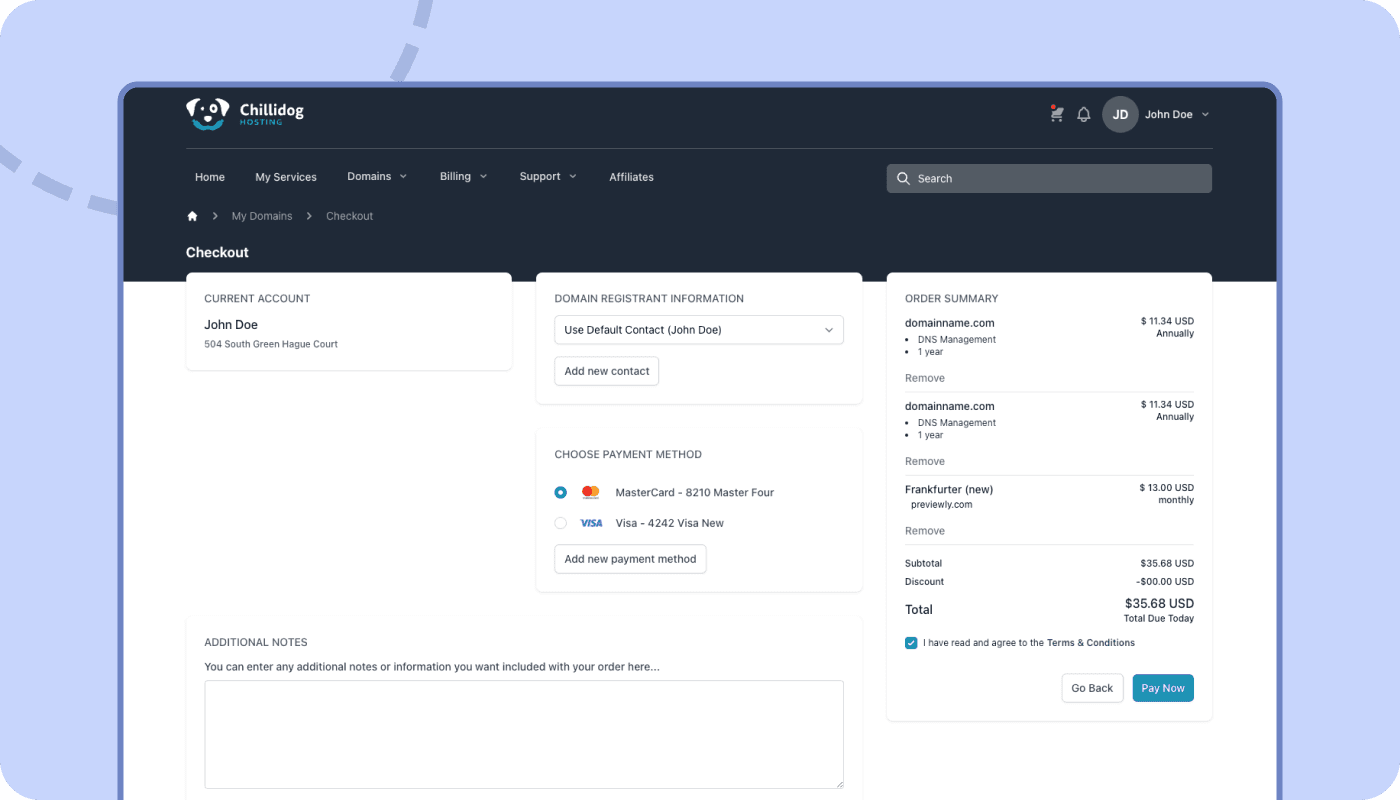
Secure and efficient payments
We replaced the legacy payment flow with a Stripe integration that handles invoices, account top-ups, and subscription management in a single, consistent experience.
Why this matters: Payment friction is churn. Every extra step between a customer and a completed transaction is an abandonment risk. More critically, customers who don't trust the payment experience don't renew. Stripe's recognized brand and clean UX removed that hesitation entirely.
Technical deep dive: Stripe’s robust API allowed us to create a secure payment system. This reduced PCI compliance scope significantly and eliminated a category of security risk that had been a background concern with the legacy system. Subscription lifecycle management (upgrades, downgrades, cancellations) is handled through Stripe webhooks, keeping the platform state automatically synchronized without manual intervention.
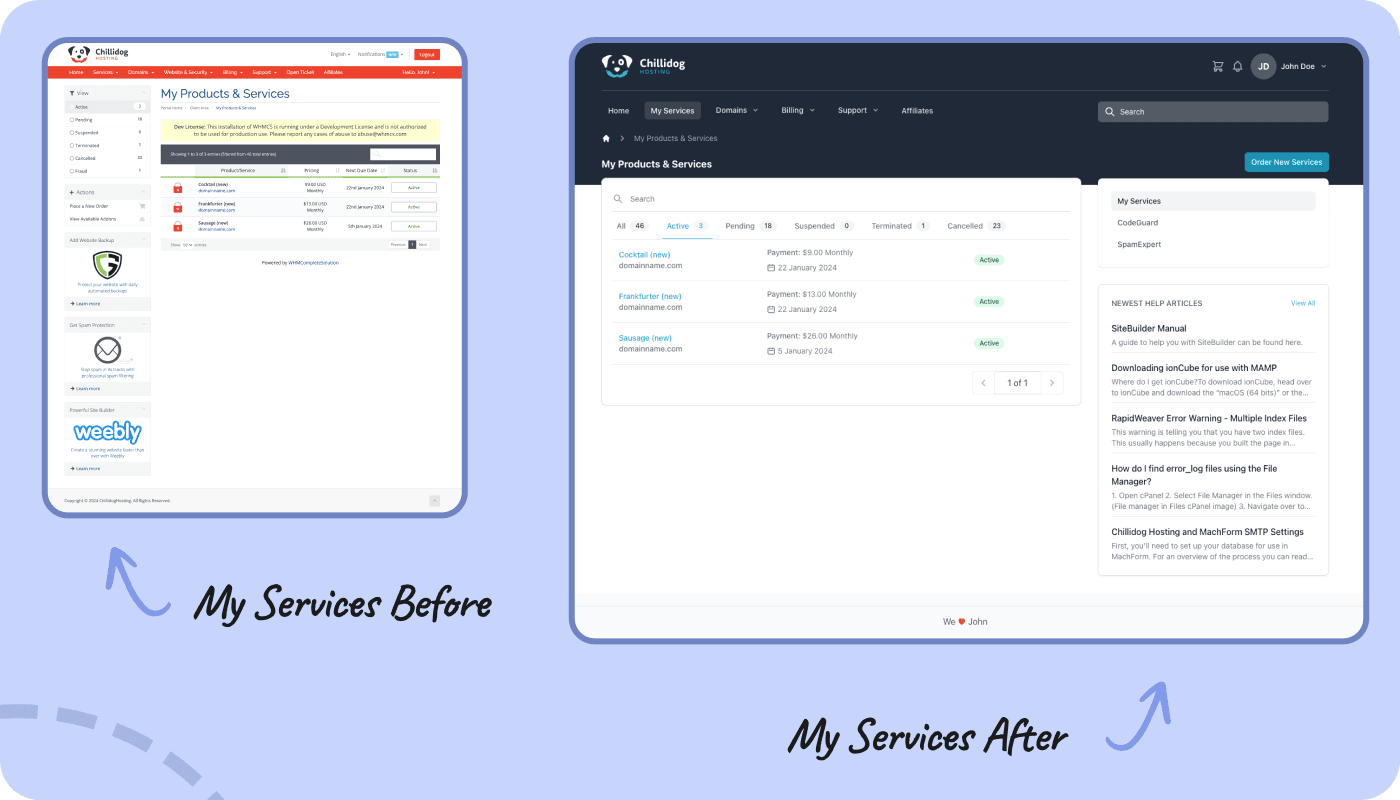
Flexible hosting services
The new platform presents Chillidog's full product catalog, US and EU server options, email security, and website backups, in a clear, configurable interface that customers can navigate and purchase from without a sales conversation.
Why this matters: The legacy system's inability to surface add-on services cleanly was leaving revenue on the table. Customers who would have purchased email security or backup services simply didn't know they existed, or couldn't complete the purchase without calling support. The new catalog structure made upsell passive, customers discover and purchase add-ons independently.
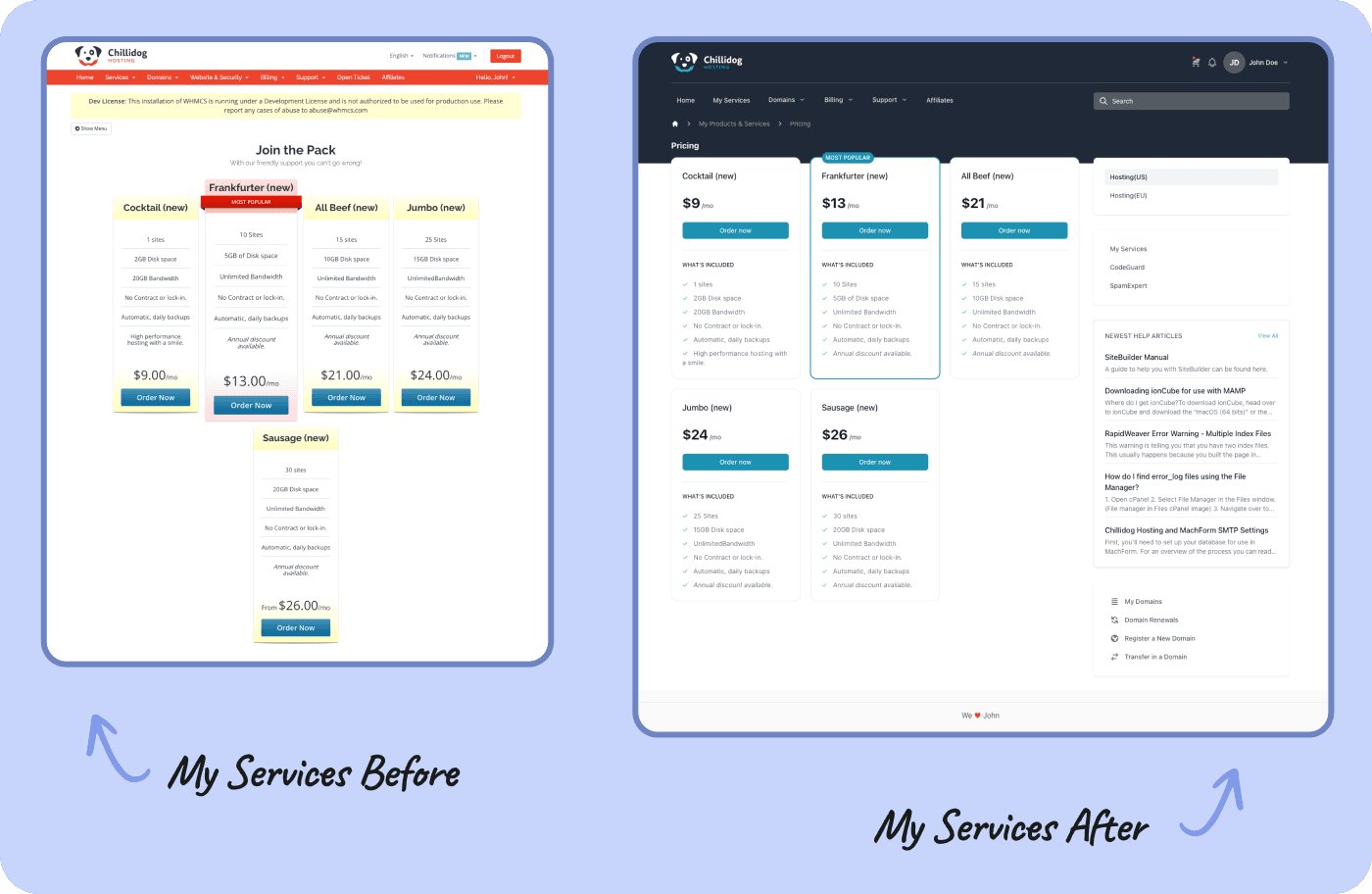
Robust support and ticket management
For issues that do require human intervention, we built a full support ticket system directly into the platform, submission, tracking, and resolution in one place, without routing customers to a third-party portal.
Why this matters: A support system that's easy to use reduces friction at the worst moment in the customer relationship. It also gives the Chillidog team structured data on what's actually going wrong, which feeds back into product decisions. The 40% ticket reduction means the tickets that remain are higher-quality signals, not noise from a confusing interface.
Let’s chat
We partner with a limited number of brands each quarter to ensure senior-level attention on every project.

The results
The transformation delivered measurable improvements within the first quarter post-launch:
40% Support Reduction: The combination of a self-service domain management workflow, a clean billing interface, and an integrated support system eliminated the friction points that had been generating the majority of ticket volume. Fewer confused customers meant lower operational costs and a support team that could focus on genuine issues rather than UI navigation questions.
70% Performance Boost: The modern Laravel/React stack on the same underlying infrastructure delivered dramatically faster response times. Page loads that had been taking multiple seconds dropped to sub-second. For a hosting company, platform speed is a direct reflection of brand credibility, customers notice, and it showed in satisfaction scores.
25% Customer Satisfaction Increase: Measured across post-interaction surveys and renewal behavior, satisfaction improvements tracked closely with the UX changes. The domain management redesign and payment flow simplification were the highest-impact contributors. Customers who can self-serve reliably don't just complain less, they renew more.
Complete Operational Scalability: The new architecture supports feature deployment and service expansion without architectural renegotiation. New hosting packages, regional options, and add-on services can be added at the product level without engineering involvement. Chillidog now has a platform that grows with the business rather than constraining it.
40%
Support Reduction
70%
Performance Boost
25%
Customer Satisfaction Increase
99%
Uptime
Why it worked
Every competing proposal recommended a full WHMCS replacement. We recommended against it. After auditing the system, it was clear that WHMCS's billing logic, provisioning workflows, and ten years of customer data were assets, not the problem. The problem was the surface layer: the interface customers had to navigate, the frontend performance, and the rigid UX that couldn't be changed without touching the backend.
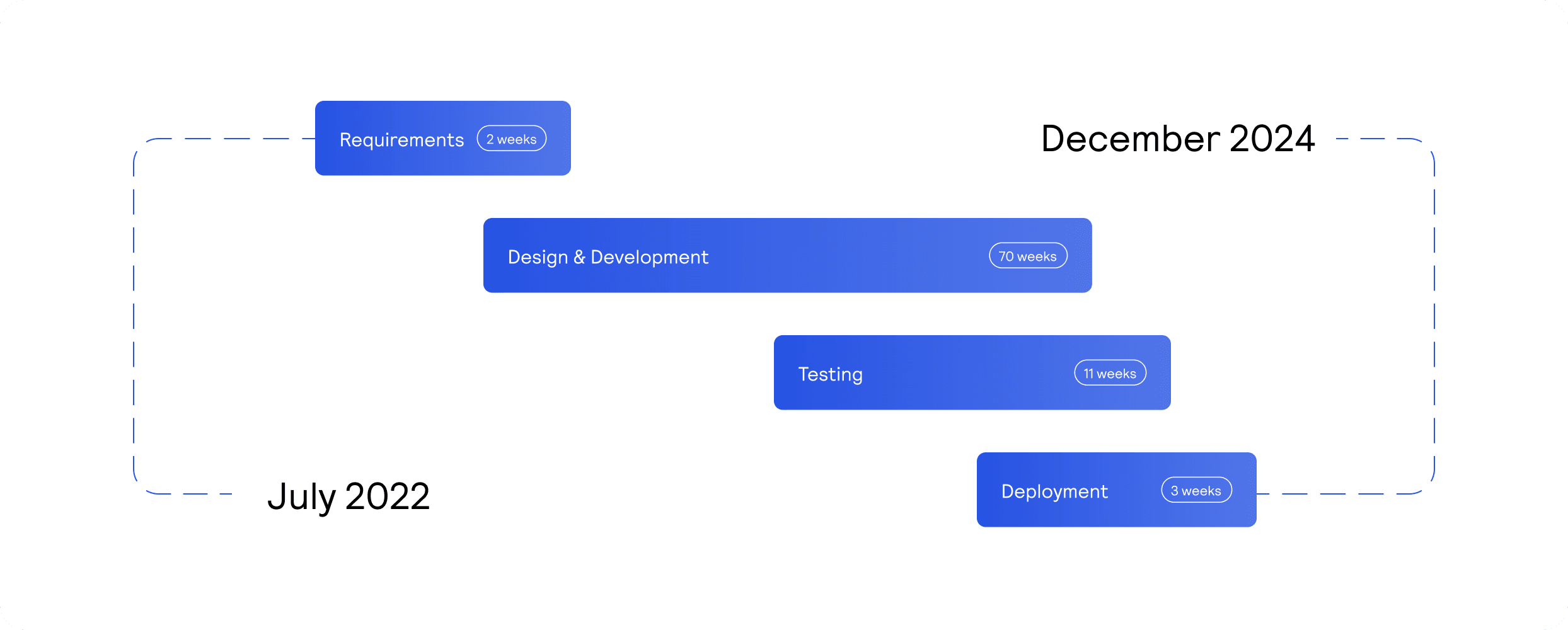
Building a modern Laravel application as a frontend layer over WHMCS, rather than replacing it, cut the project risk in half. There was no billing migration. There was no data integrity risk. There was no period where the business was running on a half-migrated system. We went live on a hard cutover with zero downtime, and the existing operational workflows kept running underneath without interruption.
That architectural judgment is the difference between a rebuild that delivers results and one that creates six months of migration risk for a marginally better outcome.
Let’s chat
We partner with a limited number of brands each quarter to ensure senior-level attention on every project.

More projects like this
AI application using Laravel and OpenAI
Tech startup saves 960 hours with AI-powered automation
Healthcare ERP system using Laravel
Medical clinic increases efficiency 340% with unified healthcare platform